The Center
The Concept
The Freiburg Center for Interactive Materials and Bioinspired Technologies (FIT) stands for basic research that forms the basis for the development of new materials and technologies. The projects conducted at FIT consist of individual research projects and long-term collaborative research projects.
The projects deal with the development of interactive and intelligent functional materials, foils and surfaces as well as material-integrated (micro)systems in order to create novel adaptive and active (polymer-based) materials.
Furthermore, inspired by models from living nature, new materials for energy conversion and energy storage are being developed and coupled with system functions. In addition, energy-autonomous embedded (micro)systems are being developed that harvest energy directly from their environment.
Another focus is on biomimetic, biobased and bioactive material systems. This includes the bioinspired and biomimetic design of materials systems and the development of new active hybrids of synthetic and biological components, as well as the bioactive functionalization of materials and (micro)systems to enable them to interact with proteins, cells and tissues.
The Building
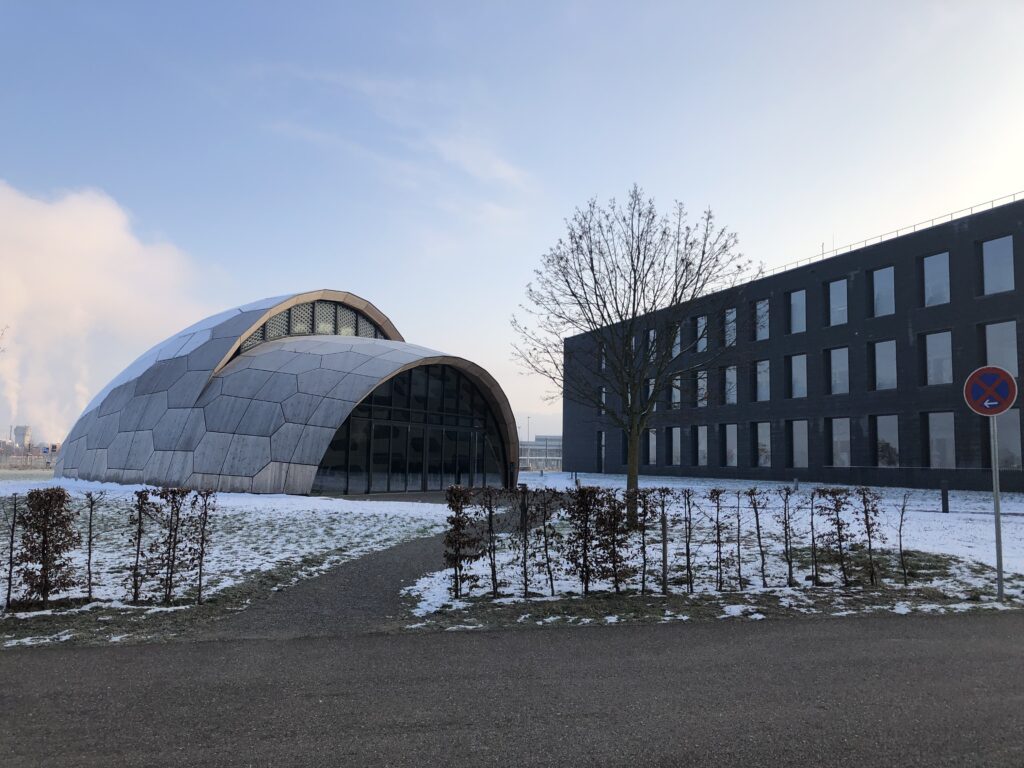
The FIT is located on the campus of the Technical Faculty at the University of Freiburg, southwest of the Freiburg Airport. The building consists of two parallel main wings, with the laboratory wing to the north and the office wing to the south. An atrium extends across the three floors in the center of the building. Bridges cross the atrium, connecting the laboratory and office areas. Each laboratory unit is made up of three rooms: a preparation room, the actual laboratory, and places for analyses separated by glass walls.
The FIT has a large lecture hall and several small seminar rooms for events and meetings. All floors have social rooms with seating areas where scientists can exchange ideas.
The FIT has a usable area of 3,240 m². Construction took place from July 2012 to December 2015. The client was the State of Baden-Württemberg, represented by Vermögen und Bau Baden-Württemberg Amt Freiburg. The total cost was 21.9 million Euros.


The Artwork in the FIT Atrium
“Transform” by Daniel Widrig
Daniel Widrig is an architect who first studied at the Nuremberg University of Applied Sciences, and then at the Architectural Association School of Architecture in London. He went on to work for several years with great success in Zaha Hadid’s office. He has received numerous awards for his work.
A total of 252 entries were initially received for the art-in-architecture competition. The subsequent implementation competition awarded first prize to the abstract sculpture by the Nuremberg-born artist who now works in London. The sculpture was also selected for the FIT. The 250-kilogram artwork, “Transform,” has impressive dimensions: 3.80 meters long, 3.80 meters wide, and 3.20 meters high.
The basic geometric shapes are extremely interesting. Their curved forms inspire a variety of associations and interpretations among the guests and scientists who work together at the Freiburg Center for Interactive Materials and Bioinspired Technologies, representing a wide range of scientific disciplines.
Cluster of Excellence livMatS
Starting in 2019, the Cluster of Excellence Living, Adaptive and Energy-autonomous Materials Systems (livMatS) has been anchored at FIT. The vision of the cluster to combine the best of two worlds — nature and technology — will be realized by a team of scientists from the fields of energy research, biomimetics and microsystems technology as well as sustainability research, psychology and philosophy.

Freiburg Research Associaton BiTS
The FIT is based on the Freiburg research association “BioInspired Technologies and Systems” (BITS), in which materials and life sciences joined forces with microsystems technology in 2006. The concept for the FIT emerged from the BITS idea. The new FIT building was approved in 2010 as part of the “Zukunftsoffensive IV Innovation und Exzellenz – Materialwissenschaftliche Zentren Baden-Württemberg”. Since 2012, it has been established as a new center at the University of Freiburg.