Research
We are engaged in several research projects
XENON
The XENON Dark Matter Project

It is know from numerous astronomical and cosmological observations that the vast majority of the energy content of the Universe is dark: so far it is invisible to our detectors. About 70% is the mysterious dark energy, responsible for the accelerated expansion of the cosmos, and about 25% is made of dark matter. This yet unknown form of matter builds large scale structures in the Universe and dominates the dynamics of galaxies and galaxy clusters. Only 5% is made from ordinary matter such as protons, neutrons, and electrons which build atoms, molecules and eventually our “known” world.
We participate in the XENON dark matter project, which aims to directly detect the particle making up the dark matter and which should be present in our cosmic neighborhood in large amounts. Its interaction probability with normal matter, and hence with particle detectors, must be extremely weak, otherwise the dark matter would not be dark. However, there are plenty of models which predict that there should be a very small interaction probability. One promising candidate is the WIMP (weakly interacting massive particle), which arises naturally in many extensions of the standard model of particle physics.
LNGS: The Laboratory
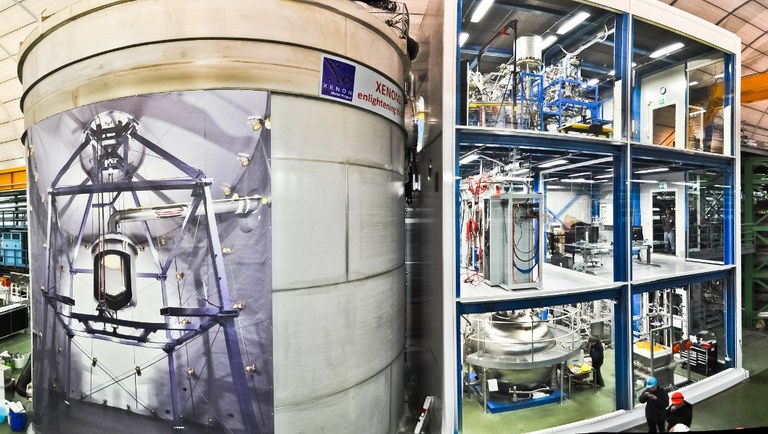
The expected interaction rate in our detector is very low, but backgrounds are large since natural radioactivity is everywhere in the environment and cosmic rays also interact with detectors. Therefore, we need a detector with an ultra-low background. In order to achieve this, the XENON detectors are placed deep underground in the Italian Gran Sasso Laboratory (LNGS, in the Abbruzzian mountains) which reduces the rate of cosmic ray muons by six orders of magnitude.
The detection principle
The XENON instruments are dual-phase time projection chambers (TPC) filled with ultra-pure xenon, which has been liquefied by cooling it to about -95°C. When a particle interacts with the xenon, it creates scintillation light and liberates electrons by ionization. Both signals, scintillation and ionization, are detected by a large number of photosensors. They are used to determine the energy deposition, the number of interactions in the detector, their 3-dimensional interaction vertex, and whether the particle looks more signal- or more background-like.
The combination of these features, together with a careful detector design and selection of all construction materials, allows achieving very low radioactive background levels – one of the prime advantages of this detector technology.
XENONnT: the current instrument
The XENON collaboration currently operates XENONnT. With a target volume of 5.9t and a 10x lower background compared to XENON1T, it is designed to explore dark matter interactions with an unprecedented sensitivity, down to the 10-48 cm² level (for spin-independent WIMP-nucleon interactions).
XENONnT start data taking in early 2021. The following images show some impressions from the construction of the detector in spring 2020. After a detector upgrade in 2025, it is resumed data taking.
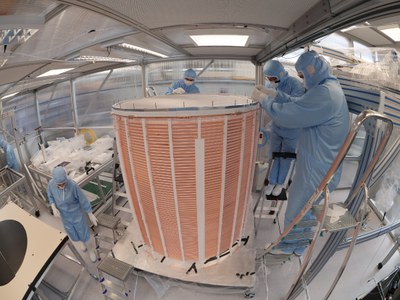 | 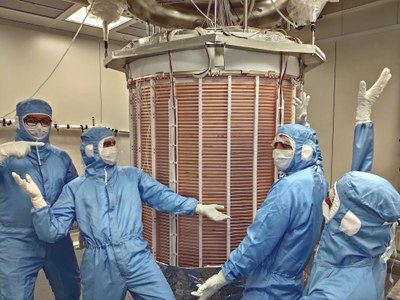 |
Construction of the XENONnT TPC. (Left) Assembly of the TPC in the above ground cleanroom. (Right) Part of the Freiburg team during installation underground.
The responsibilities of the Freiburg group for XENONnT are:
- Data acquisition and electronics: We are responsible for the electronics and the data acquisition system for XENONnT. Our asynchronous trigger-less readout system with virtually no threshold developed for XENON1T was re-used and combined with a very fast online processing tool.
XENONnT also features a dedicated high-energy readout channel to search for the neutrinoless double-beta decay of 136Xe. - Detector design: We were co-leading the design of the time projection chamber (TPC) of XENONnT with an emphasis on the elements ensuring the field homogeneity of the TPC field cage. We were providing levelmeters for the TPC as well as low-background high voltage connectors, and we manufactured many parts of the detector.
- Monte Carlo and backgrounds: We were involved in building the Monte Carlo model of XENONnT and used it extensively to check whether the cleanliness of materials is sufficient for the use in the actual experiment. We contributed to the material selection campaign with our low-background spectrometer GeMSE.
XENON is an international collaboration with more than 200 members from Germany, USA, Italy, Switzerland, France, the Netherlands, Sweden, Portugal, UAE, Israel, and Japan.
Further Information
Dark Matter and dual-phase Liquid Xenon Detectors
- Direct Detection of WIMP Dark Matter: Concepts and Status:
M. Schumann, J. Phys. G: Nucl. Part. Phys., arXiv:1903.03026 - Liquid Xenon Detectors: M. Schumann, JINST 9, C08004 (2014), arXiv:1405.7600.
XENONnT
- First Search for Light Dark Matter in the Neutrino Fog with XENONnT
E. Aprile et al. (XENON), Phys. Rev. Lett. 134, 111802 (2025), arXiv:2409.17868 - First Indication of Solar 8B Neutrinos via Coherent Elastic Neutrino-Nucleus Scattering with XENONnT
E. Aprile et al. (XENON), Phys. Rev. Lett. 133, 191002 (2024), arXiv:2408.02877 - Search for New Physics in Electronic Recoil Data from XENONnT
E. Aprile et al. (XENON), Phys. Rev. Lett. 19, 161805 (2022), arXiv:2207.11330 - The XENONnT Dark Matter Experiment
E. Aprile et al. (XENON), Eur. Phys. J. C 84, 784 (2024), arXiv:2402.10446
XENON1T
- XENON1T: Results from Science Run 1
E. Aprile et al. (XENON), Phys. Rev. Lett. 121, 111302 (2018), arXiv:1805.12562 - XENON1T Instrument Paper:
E. Aprile et al. (XENON), Eur. Phys. J. C 77, 881 (2017), arXiv:1708.07051
XENON100
- XENON100 Instrument Paper:
E. Aprile et al. (XENON100), Astropart. Phys. 35, 573 (2012), arXiv:1107.2155. - XENON100 WIMP result:
E. Aprile et al. (XENON100), Phys. Rev. Lett. 109, 131801 (2012), arXiv:1207.5988. - Annual Modulation Analysis:
E. Aprile et al. (XENON00), Phys. Rev. Lett. 115, 091302 (2015), arXiv:1507.07748.
XLZD
The ultimate low-background observatory

Dark matter experiments with target masses well beyond the ton scale are already reality. Our group participates in XENON which currently operates a detector filled with more than 8 tons of liquid xenon, of which 5.9 tons act as dark matter target.
XLZD is a proposed, even larger low-background observatory to search for dark matter, neutrinoless double-beta decay and many other rate process. The project combines the expertise of many experimental physicists working with liquid xenon to detect dark matter, uniting members from the XENON, LUX-ZEPLIN, DARWIN, XMASS and EXO collaborations. The XLZD detector will have a target mass of at least 60 tons of liquid xenon.

A detector of this size will be limited by background from neutrinos which, however, are also an interesting physics case itself. Typical neutrino experiment has much higher thresholds but XLZD could directly measure low energetic solar neutrinos (pp, 7Be). Thanks to its extremely low background as well as low threshold, many other science channels will be accessible in XLZD, including supernova neutrinos, axions/axion-like particles as well as rare decays of 136Xe and 124Xe.
The Freiburg group currently concentrates on the following topics:
- We study possibilities to build such large detectors/time projection chambers and pursue dedicated experiments to study alternative or improved detector concepts.
This work was also supported by the ERC Consolidator Grant ULTIMATE from the European Commission, project number 724320. - We are operating the world’s largest LXe detector test platform PANCAKE, which allows studying and developing of TPC components with a diameter of more than 2.6m (but of limited height).
- We participate in studies on the physics reach of such a large detector with its extraordinary low radioactive background.
- We operate and develop instruments to identify low-background materials and components.
XLZD is an international consortium of more than 420 people. It combines ample expertise on dark matter search with liquid xenon, from neutrino and high energy physics, and with backgrounds from extremely low backgrounds to particle physics theory.
Marc Schumann serves as co-spokesperson of the XLZD collaboration.
Further Information
- Official XLZD website
- J. Aalbers et al. (XLZD), The XLZD Design Book: Towards the Next-Generation Liquid Xenon Observatory for Dark Matter and Neutrino Physics, Eur. Phys. J. C 85, 1192 (2025), arXiv:2410.17137
- J. Aalbers et al. (XLZD), Neutrinoless Double Beta Decay Sensitivity of the XLZD Rare Event Observatory, J. Phys. G 52, 045102 (2025), arXiv:2410.19016
- J. Aalbers et al. (DARWIN, LZ, XENON Collaborations at al.), A Next-Generation Liquid Xenon Observatory for Dark Matter and Neutrino Physics, J. Phys. G 50, 013001 (2023), arXiv:2203.02309
- J. Aalbers et al. (DARWIN), DARWIN: towards the ultimate dark matter detector, JCAP 11, 017 (2016)
DELight
Searching for light dark matter with liquid helium

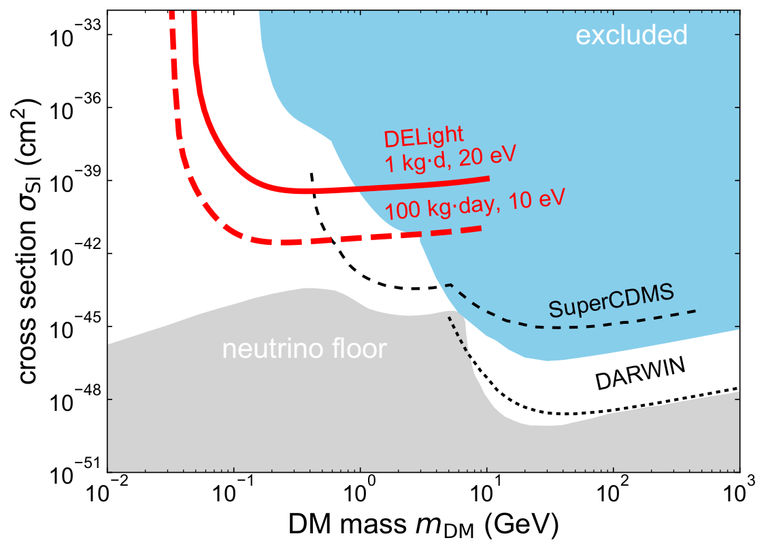
The “traditional” mass range of dark matter in form of weakly interacting particles (WIMPs) is around 100 GeV/c², the so-called weak scale. However, as no dark matter particle was found so far, low-mass or light dark matter (LDM) has gained more attention recently. The idea is that the dark matter particle is too light to generate a signal in the most sensitive detectors to date, e.g., XENONnT.
Thus new detector concepts have to be developed to seach for light dark matter. DELight combines the expertise available at the University of Freiburg, the Karlsruhe Institute of Technology (KIT) and Heidelberg University to design, realize and operate a detector using cryogenic liquid helium (4He) as dark matter target. Already moderate exposures obtained with relatively small detectors will be able to explore far into the not-yet probed LDM parameter space (see image).
The Freiburg Astroparticle Physics Group contributes to the following aspects of DELight:
- low-background environment: using our dedicated instruments and expertise to design and build experiments with very low backgrounds. We will also work on the background simulations.
- site and infrastructure: DELight will be installed in the Vue-des-Alpes Underground laboratory for its first low-background run. Freiburg has access to this laboratory via its close ties to the University of Bern
- slow control: we will use our well-established slow control system Doberman to operate and monitor DELight
Further Information
- Webpage of DELight
- F. Toschi et al. (DELight), Signal partitioning in superfluid 4He: a Monte Carlo approach, Phys. Rev. D 111, 032013 (2025), arxiv:2410.13684
- B. von Krosigk et al, DELight: a Direct search Experiment for Light dark matter with superfluid helium, SciPost Phys. Proc. 12, 016 (2023), arXiv:2209.10950
SHiP
Search for hidden particles at CERN

SHiP is a future general-purpose experiment to be installed at ECN3 at CERN’s SPS to search for hidden particles. These are predicted by many theoretical models of so-called “Hidden Sectors”. These models are addressing some of the most pressing questions in modern particle physics, such as dark matter, neutrino oscillations, and the origin of the baryon asymmetry in the Universe.
The SHiP experiment was approved by CERN in spring 2024. It aims at searching for very weakly interacting long lived particles including Heavy Neutral Leptons — right-handed partners of the active neutrinos, vector, scalar, axion portals to the Hidden Sector, and light supersymmetric particles, etc. The high intensity and the high energy of the Super Proton Synchrotron (SPS) beam together with the large production cross section of charm mesons and photons allow accessing a wide variety of light, long-lived and neutral exotic particles of such models and of supersymmetric particles as well.
The SHiP detector consists of two complementary instruments, capable of searching for hidden particles through both visible decays and scattering signatures from recoils of electrons or nuclei. These are the scattering and neutrino detector (SND) and the hidden sector decay spectrometer (HS).

The technical description of the SHiP facility can be found in the Comprehensive Design Study Report and the physics case of is summarized in this article.
The decay spectrometer and the surround background tagger
The HS decay spectrometer aims at measuring the visible decays of HS particles by reconstructing their decay vertices in a 50 m long decay volume. This decay volume is evacuated to eliminate the background from neutrinos interacting in the decay volume. Charged and neutral decay particles are identified in a spectrometer behind the decay volume, consisting of a straw tracker (SST), an electromagnetic calorimeter (ECAL) and a muon detector. The decay volume walls are instrumented by the liquid scintillator-filled surround background tagger (SBT) to identify neutrino- and muon-induced inelastic interactions in the decay volume walls. These may produce backgrounds that decay in the decay volume and mimick signal events.
The Freiburg Astroparticle Physics group joined SHiP in 2021 and contributes to the SBT, in particular to the liquid scintillator cells and the readout electronics. In the last years we designed, constructed and operated several full-scale detector cells (operated testbeams at CERN and DESY) and a full-scale 2×2 detector module (operated at the CERN testbeam). At the moment, the R&D towards the technical design report (TDR) is ongoing.
Further Information
- SHiP Experiment at CERN: Hidden Particles
- C. Ahdida et al. (SHiP Collaboration), The SHiP experiment at the proposed CERN SPS Beam Dump Facility, Eur. Phys. J.C 82, 486 (2022), arXiv:2112:01487
- J. Alt et al. (SHiP-SBT), Performance of a First Full-Size WOM-Based Liquid Scintillator Detector Cell as Prototype for the SHiP Surrounding Background Tagger, JINST 19, P05024 (2024), arXiv:2311.07340
- A. Brignoli et al. (SHiP-SBT), Performance of Prototypes with Different Reflector Materials for the SHiP Liquid Scintillator Surrounding Background Tagger, JINST 20, P07023 (2025), arXiv:2503.10250
AMBER
Studying the Structure of the Proton

AMBER (Apparatus for Meson and Baryon Experimental Research) is the next-generation successor of the CERN’s COMPASS experiment. It studies questions about fundamental properties of the proton, including its size (“proton radius”), intrinsic spin and internal structure.
AMBER directs particle beams from the CERN SPS onto various fixed targets to study how quarks and gluons combine in hadrons and give rise to their distinctive properties. AMBER builds on COMPASS’s legacy by upgrading the existing COMPASS detectors and by adding new detectors and targets. The readout and data acquisition systems will also be upgraded to achieve the science goals .
The original COMPASS experiment was approved back in 1997 by CERN authorities. The centerpiece of the experiment, a two stage open field spectrometer, was installed in the following years from 1999 – 2000 and was commissioned finally in 2001. Data taking started in summer 2002 and is ongoing since then.
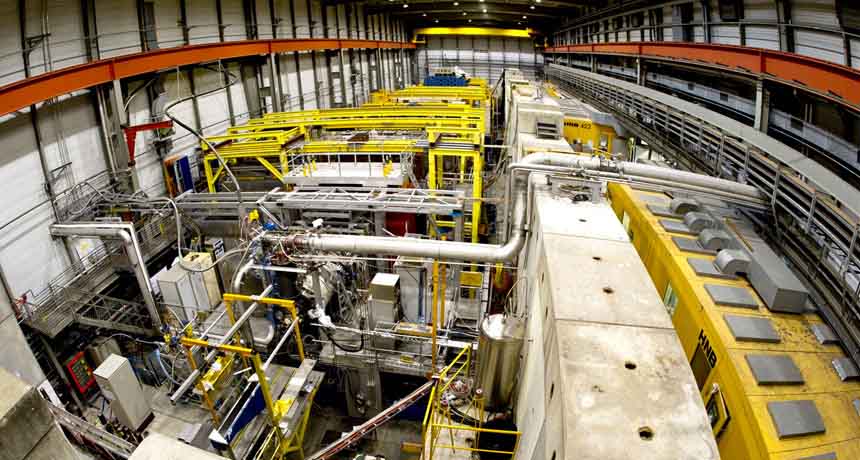
AMBER is built on the COMPASS legacy. It is thus the oldest active experiment CERN. Still nearly 240 physicists from 12 countries and 23 institutions work in AMBER. Our group is responsible for a major part of the detector readout electronics.
Further Information
Liquid xenon detector R&D
Making an excellent detector technology even better
We aim at overcoming shortcomings of the current generation of liquid xenon detectors by exploring novel detector designs and concepts.
These projects are usually conducted in our laboratory in Freiburg, making use of our two liquid-xenon detector test platforms PANCAKE and XeBRA, as well as of our cleanroom infrastructure. They are ideal projects for Master and Bachelor theses.

Recent Highlights
- The first operation of a single-phase xenon TPC, where the secondary scintillation signal is generated in the liquid xenon phase.
Article: Proportional scintillation in liquid xenon: demonstration in a single-phase liquid-only time projection chamber, F. Tönnies et al., JINST 19, P09032 (2024),arXiv:2405.10687 - The demonstration that a hermetic TPC, where the liquid xenon inventory inside the TPC is mechanically separated from the inventory surrounding the detector, can be operated. This technology is very appealing to further reduce 222Rn-induced background.
Article: Reduction of 222Rn-induced Backgrounds in a Hermetic Dual-Phase Xenon Time Projection Chamber, J. Dierle et al., Eur. Phys. J C 83, 9 (2023), arXiv:2209.00362 - The first operation of a shallow TPC with more than 1.3m diameter and an active xenon mass of 127kg in an un-shielded environment above ground.
Article: Operating a large-diameter dual-phase liquid xenon TPC in the unshielded PANCAKE facility, J. Müller et al., Eur. Phys. J. C 86, 735 (2026), arXiv:2601.15938
Low Background
Development of low-background methods

Experiments searching for rare events, such as for interactions from dark matter particles, need to have radioactive backgrounds as low as possible. This background comes from various sources:
- Natural radioactive contaminations (mainly U, Th, K) in the detector construction materials (enclosure, cables, etc), leading to gamma-rays as well as neutrons (from (α,n)-reactions and spontaneous fission).
- Alpha, beta, or gamma-backgrounds from the detector material itself.
- Gamma- and neutron background from the experimental environment (laboratory walls, etc).
- Muons, (muon-induced) neutrons, or hadronic cosmic rays from the Earth’s atmosphere.
There are various methods to reduce or even eliminate (the latter is usually not possible completely) each of these sources. These include the selection of very radio-pure materials to build the experiment, optimized detector design, as well as placing it in deep-underground laboratories. Our group works in the medium-depth Vue-des-Alpes laboratory in Switzerland, and performs experiments at the undergound laboratory LNGS (Italy).
We work on several topics in order to make dark matter detectors better in various aspects.
Background Reduction
We work on reducing or understanding possible backgrounds for low-background detectors. Examples are the study of cosmogenic activation of materials and the development of low-background detector components.
GeMSE: Gamma-ray spectroscopy
The GeMSE (Germanium Material and Meteorite Screening Experiment) gamma-screening facility is used to select radiopure materials for the construction of low-background detectors for rare event searches (XENON, XLZD). It is the first detector world-wide with a dedicated program to measure the cosmogenic activation of meteorites.
GeMSE consists of a low-background high-purity p-type germanium crystal (2.0 kg), installed in a massive shield featuring a large sample cavity of 20 liters. The detector is installed in the Swiss Vue-des-Alpes underground laboratory (620 mwe, in the Jura mountains) and is constantly used for measurements.

- M. v. Sivers et al., JINST 11 P12017 (2016), arXiv:1606.03983.
- D. Ramirez Garcia et al., JINST 17, P04005 (2022), arXiv:2202.06540
- Å.V. Rosén et al., Meteorit. Planet. Sci. 56, 2017 (2021)
- B.A. Hofmann et al., Journal of Archaeological Science 157, 105827 (2023)
MonXe: Radon-emanation detector
Our radon emanation detector MonXe measures the radon (Rn) emanation rate of materials. The noble gas Rn is emitted from surfaces and can make it into the dark matter target producing critical backgrounds. MonXe is used to identify clean materials.
MonXe is located in the laboratory at the 6th floor of the physics highrise in Freiburg.
- D. Wiebe, S. Lindemann, M. Schumann, JINST 19, P04014 (2024), arXiv:2309.04514
Both systems, GeMSE and MonXe are operated and controlled by Doberman, a flexible Slow Control application developed for small and medium-scale projects.
Further Information
- Backgrounds and Background Reduction:
M. Schumann, J. Phys. G: Nucl. Part. Phys., arXiv:1903.03026 - XENON100 Material Screening:
E. Aprile et al. (XENON100), Astropart. Phys. 35, 43 (2011), arXiv:1101.5831. - XENON1T Material Screening:
E. Aprile et al. (XENON), Eur. Phys. J C 77, 890 (2017), arXiv:1705.01828 - XENONnT Material Screening:
E. Aprile et al. (XENON), Eur. Phys. J. C 82, 599 (2022), arXiv:2112.05629 - Cosmogenic Activation of Xe and Cu:
L. Baudis et al., Eur. Phys. J. C 75, 485 (2015), arXiv:1507.03792