80 Years after the End of the War in Europe: How Stable Is the Postwar Order?
Freiburg, 22/04/2025
How stable is the world order that took shape after 1945 – and what will happen if its foundations crumble? In our interview, the Freiburg historian Jun.-Prof. Dr. Elisabeth Piller speaks about the fragile transatlantic relations and draws historical parallels between postwar periods. It is a discussion of shifts of power, emotional breaks – and the end of cherished certainties.
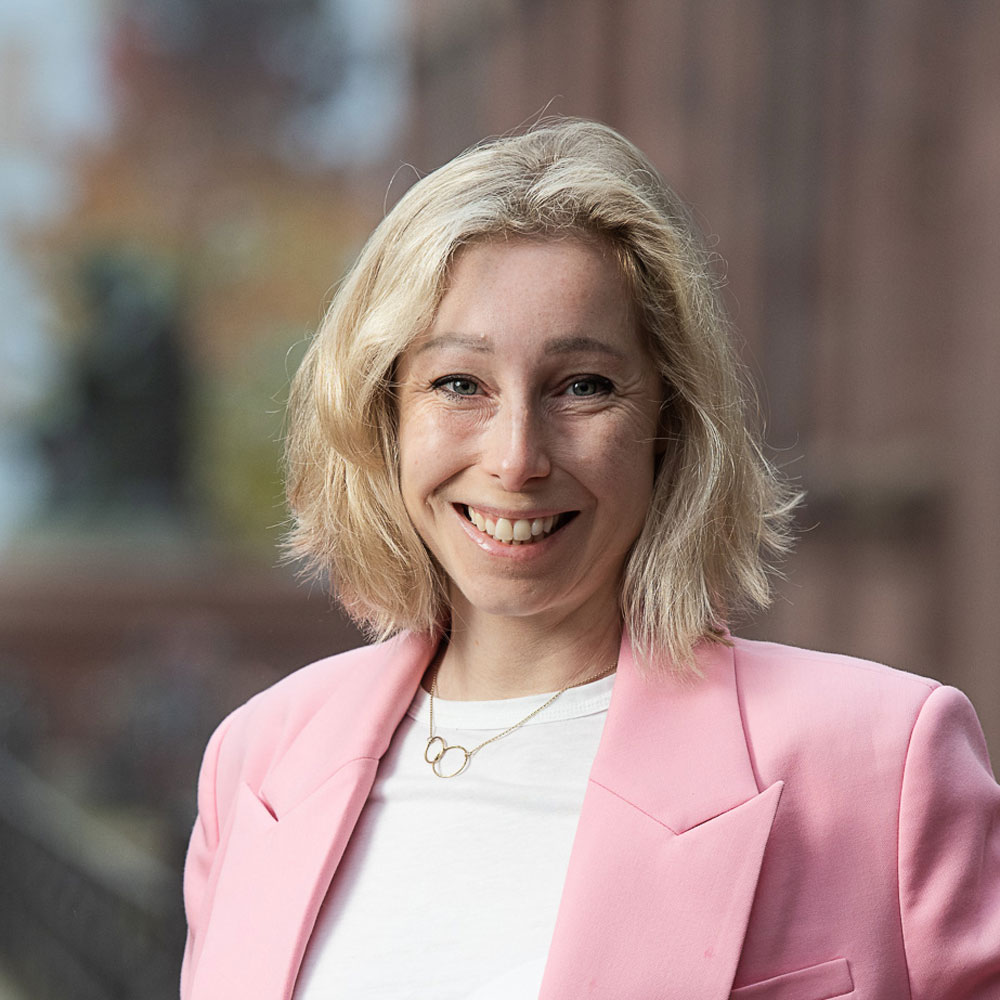
Is the postwar order that took shape after 1945 – with NATO and the USA as guarantors of German security – currently in danger?
I would say that it’s at least on very shaky ground. The cooperation in NATO has always been prone to conflict (one need only think of Charles de Gaulle in the 1960s), but the American promise of security has never been called into question so flagrantly. German society is now forced to scrutinize many cherished certainties, as we are evidently dealing with an America that is not only more isolationist but above all one that thinks more in terms of power politics. It was always one of the basic premises of the postwar order that the USA should act out its hegemony within a multilateral framework and with public emphasis on cooperative aspects – at least with regard to Europe.
Since the founding of the Federal Republic, the transatlantic relations between Germany and the USA have always been integral to the identity of the two countries. We’re now observing how the new US government is swiftly distancing itself from this mindset. Can a partnership that has evolved over the course of decades break within just a few months or years?
Yes and no. Transatlantic relations have always been based on a combination of common interests and mutual trust. The common interests have been weakened for decades. Since Obama, Washinton has regarded China as the main trade policy and potential geopolitical threat on which American resources should be concentrated. The war in Ukraine and the presidency of Joe Biden, probably the last US president to be socialized as a politician entirely in the Cold War era, only brought a brief and superficial turning away from the already initiated shift in foreign policy, concealing the country’s orientation towards Asia. For Europe, what this means and should have meant for decades is that we have to reposition ourselves; for someone who – like the current American president – regards foreign relations in terms of a cost–benefit ratio, Europe has little to offer. What it also means, however, is that if Europe can offer the USA something again in terms of burden sharing, it will also again be possible in the long term to define common security interests.
Panel discussion: 1945 | 2025: Postwar Eras: Historical Experiences and Current Challenges
On the occasion of the 80th anniversary of the end of World War II, political scientists and historians will meet on 28 April to discuss the historical experience of postwar eras – not least ‘the’ postwar era after 1945 – and their connection with current wars, particularly the war in Ukraine.
When: 7 p.m.
Where: Universitäty of Freiburg, KG I, Aula
This event will be held in German.
Whether it will be possible to rebuild transatlantic trust is quite a different matter. International relations are always both rational and highly emotional, and the latter applies in particular to (West) German relations with the USA. Certainly, European distrust is strongly linked to Trump’s person and that of his vice president and can therefore diminish again after a change in leadership. Nevertheless, I sense that the relations could be permanently damaged among committed transatlanticists in particular. Under Trump, the USA has shifted away very clearly from the accustomed friendly rhetoric and treats Europe – as Volodymyr Zelenskyy recently had to experience – more or less like a client state. The demand for gratitude and gestures of humility has – at least in public – rarely been articulated in transatlantic relations. So even if it turns out to be possible to restore the transatlantic congruence of interests, I’m not sure how quickly and enduringly transatlantic trust can be repaired. I believe that it will be very difficult, at least with regard to the Trump II administration or a like-minded subsequent administration.
“Whether it will be possible to rebuild transatlantic trust is quite a different matter. International relations are always both rational and highly emotional, and the latter applies in particular to (West) German relations with the USA.”
Jun.-Prof. Dr. Elisabeth Piller
Junior professor at the Department of History at the University of Freiburg
If you look at various postwar periods from different epochs, can you identify a pattern in the various stages postwar societies go through (such as developing and collapsing again)? If so, what does it look like?
That cannot be generalized, at least not for me as a historian. Postwar periods are too different for that, and postwar experiences depend too much on various factors, not least on the outcome of the war. It does not just depend on whether one was (and feels like) the loser or the winner but also on what devastation the war wreaked in one’s own country or, for example, on the world economy.
However, we have identified overarching patterns in the ‘Postwar Periods’ project group at FRIAS, which is comparing the postwar periods after 1648 and after 1945, among other things. Postwar periods often confront societies and states with similar challenges, such as how to deal with veterans, war widows, and war orphans; they raise questions concerning reconstruction and the new order, the answer to which often oscillates between a return (or an attempted return) to the status quo and a more radical change of direction. Postwar periods are thus times of transition and renegotiation. That makes them historically interesting and politically challenging: After a war, the social status of individual groups is often renegotiated, the fabric of cities discussed, or even the entire structure of the state brought into a new balance. We see this after World War II, for example, in the new or renewed constitutions adopted not only in Germany, Japan, Italy, and France but in a total of almost fifty countries. Thus, postwar periods open up a window of opportunity for far-reaching changes; but they are also marked by the attempt to redistribute the costs of the war internationally and nationally, which can stir up new tensions.
Another point you will take up in the panel discussion is the extent to which different historical experiences of the postwar era after 1945 influence opinions in the West and East today. We can observe the consequences of these experiences and their interpretation for one’s own country today for Russia and the USA in particular. In your opinion, is the experience after 1945 or that after 1990 more significant for our present and why?
That’s difficult to answer in general terms. What is certain, however, is that the experience of the disintegration of the Soviet Union and the international déclassement of Russia was a decisive turning point for Vladimir Putin, also in biographical terms, and it is a determining factor in his actions towards Ukraine and the West today. At the same time, his stance is based in part on his perception of the Soviet Union as one of two global superpowers, which was of course the result of the victory over Nazi Germany. Thus, experiences and perceptions of the two postwar periods are bound up together, and the interplay between them – as a ‘rise and fall’ narrative – seems to be particularly influential.
“The slogan ‘Make America Great Again’ raises the question of which America should be made great again or when American was actually ‘great’.”
Jun.-Prof. Dr. Elisabeth Piller
Junior professor at the Department of History at the University of Freiburg
However, I would say that the postwar period after 1945 is also highly significant for Donald Trump. The slogan ‘Make America Great Again’ raises the question of which America should be made great again or when American was actually ‘great’. The America Trump is referring to is apparently that of the postwar years in which he himself (born in 1946) grew up: the prosperous, producing American that was far superior to the rest of the world, at least in terms of prosperity. The break of 1989 of course also plays a role for Trump and his supporters. The unipolar moment of the early 1990s fuelled the idea of an American hegemony, whereas the third wave of globalization after the end of the Cold War also hastened the decline of many traditional American industries.
What effect do these experiences have on Putin’s and Trump’s actions with regard to the EU, Ukraine, and the Israel–Gaza conflict?
That will be a topic we will cover in detail at the panel discussion, and I’m delighted that we’ll be able to draw on the expertise of several proven Eastern Europe experts. Characteristic of Trump, it seems to me, is the great significance he attaches to American support of Israel – a product of the postwar years. It would certainly be interesting to consider why Israel, in contrast to Europe, can still rely so heavily on American support.
Another relevant point I see is Donald Trump’s very entrepreneurial view of questions of reconstruction. Just consider his statement in February that the USA would take over the Gaza Strip after the war, build up flourishing landscapes there, and finally exhaust the touristic potential of the long coastal strip. The building contractor Trump already had visions of exclusive hotel buildings with private beaches and spoke of a ‘Riviera of the Middle East’. You might consider that absurd, but behind it is the pressing problem of what to do with a destroyed country strewn with landmines and a population that will perhaps not have found peace. Trump’s view is influenced by his own professional background, but it seems to me that it also owes a lot to American recovery programmes like the Marshall Plan.
We want to discuss all these problems this coming Monday, as well as that of how to build up a stable postwar order when the foundations of our own postwar order at beginning to totter.
About Elisabeth Piller
Jun.-Prof. Dr. Elisabeth Piller has served since November 2020 as a junior professor at the University of Freiburg’s Department of History, where she researches and teaches on the history of the United States and transatlantic relations. Her research focuses on American foreign policy and relations between the USA and Europe since the end of the nineteenth century.
Her current research project, ‘The Good Samaritan of All the World—US Humanitarians, Postwar Europe, and the Making of the American Century’, is devoted to American humanitarian foreign aid after World War II and traces the rise of the USA to a (humanitarian) superpower. Piller is a principal investigator of the Cluster of Excellence initiative ‘ConTrans: Constitution as Practice in Times of Transformation’ and a member of the FRIAS project group ‘Postwar Periods’. In 2024 she received an ERC Synergy Grant for her research project ‘BLOCKADE – The Hidden Weapon: Blockade in the Era of the World Wars’.