MangrovES – Mangrove Governance Innovation for Sustainable Ecosystem Service Provision
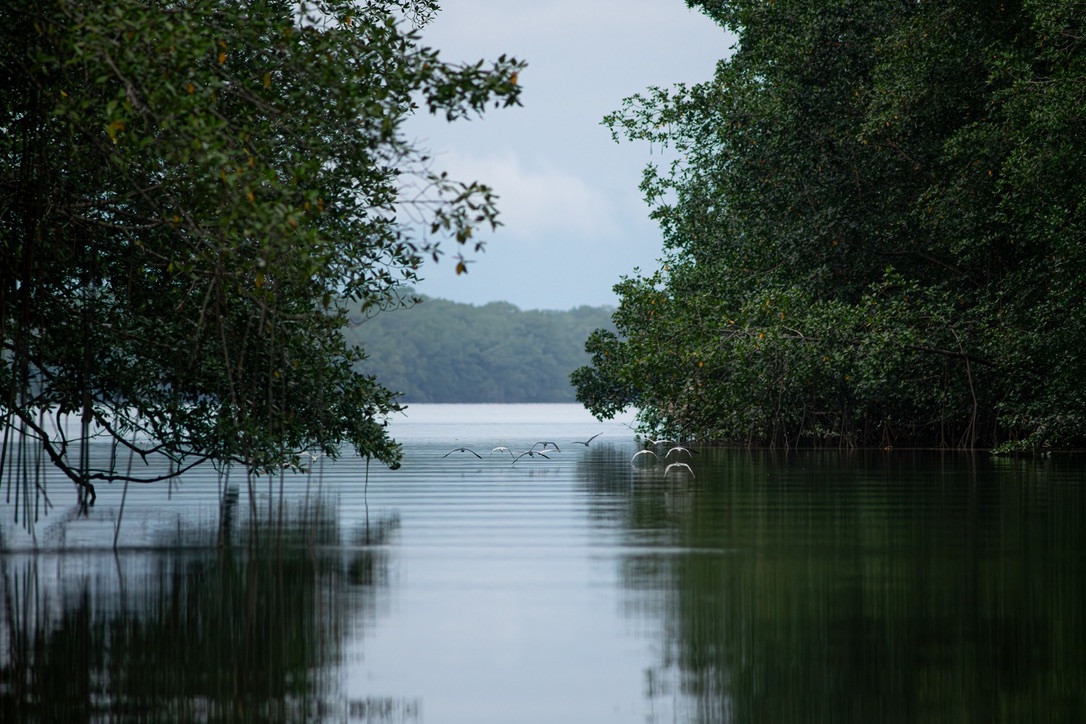
The MangrovES project is a comprehensive research initiative led by Professor Daniela Kleinschmit and Stefan Sorge at the University of Freiburg. It is conducted in collaboration with CEMarin in Colombia and the Leibniz Centre for Tropical Marine Research (ZMT) in Germany. This pioneering study focuses on developing innovative governance approaches for mangrove forest management, integrating ecological, social and economic factors to ensure the sustainable provision of ecosystem services.
Despite covering only 0.7% of the world’s tropical forest area, mangrove forests provide critical ecosystem services to over 120 million people globally. These unique coastal ecosystems act as natural barriers against storm surges and flooding, support biodiversity, and store up to five times more carbon per hectare than most tropical forests. They also provide essential resources, such as food and timber, and hold cultural value. However, mangroves are under threat from deforestation, climate change, urban development and complex governance issues that vary significantly from region to region.
Study Regions
The research focuses on three distinct Innovation Regions in Colombia, each offering unique ecological and socio-economic contexts:
- Punta Soldado (Pacific Coast – Valle del Cauca)
An innovative approach combining scientific tourism within mangroves, creating learning platforms for local inhabitants and researchers while providing alternative income sources and capacity building opportunities. - Bahía de Malaga (Pacific Coast – Valle del Cauca)
Neighbouring initiatives on REDD+ and blue carbon that enable study of transfer processes, cooperation, and knowledge co-creation between regions within the same coastal area. The initiatives are partly implemented, managed by the Ministry of Environment (Colombia). - „Vida Manglar“ (Caribbean Coast)
A pioneering Blue Carbon Scheme operating for 10-15 years, representing the world’s first such initiative with diverse stakeholder participation from private, public, civil society, and academic sectors across three national departments.
Methodology and Framework
The research employs the Social-Ecological-Technical-Forestry-Innovation-Systems (SETFIS) analytical framework, which builds upon Elinor Ostrom’s Socio-Ecological Systems Framework. This comprehensive approach integrates multiple disciplines including social and political science, economics, forestry, ecology, and transition science within a multilevel governance environment.
Work Packages / Research Objectives
The project has four specific objectives and related work packages, which it pursues through the development of a governance framework:
The project expands knowledge transfer beyond the initial three study regions by establishing Tumaco, Nariño, as a fourth innovation region. Building on existing local initiatives for mangrove conservation, sustainable use, and education, the project draws on insights from other Innovation Regions to support the formalisation and advancement of these efforts. Drawing upon Colombia’s experience, international expansion will occur through structured partnerships under the MangrovES project, addressing prior gaps by establishing a coherent framework for knowledge transfer. This global component engages at least four master’s students who will apply and refine the SETFIS framework across diverse cultural and ecological contexts, leveraging networks such as ZMT and IUFRO to identify suitable sites in tropical regions of Africa and Asia.
The approach aims to assess the adaptability of the governance framework while enabling South–North and South–South learning exchanges that strengthen both local and global understanding of mangrove management. At multiple stakeholder levels, the project promotes community-based resource management, supports local enterprises, and builds stronger links between science, policy, and practice. It contributes directly to climate change mitigation, biodiversity conservation, and the Sustainable Development Goals by fostering scalable governance solutions for mangrove ecosystems. Through its integration of research, education, and partnership-building, the MangrovES project represents a step toward globally relevant, sustainable coastal ecosystem management.
Publications
- Sorge, S., Zapata Delgado, N., Romero Mera, C.A., Mosquera Murillo, M., Salazar Ibargüen, M.L., Sinisterra Vergara, M., Mosquera, L.F. (2025). Piangüeras: guardians of the mangrove in the Colombian Pacific. TFI63: Women as Stewards of Forests, 1.1, 3–10. https://doi.org/10.55515/GKIO9649
Original work of the analytical framework further developed within the project:
- Sorge, S., Mann, C., Schleyer, C., Loft, L., Spacek, M., Hernández-Morcillo, M., Kluvankova, T. (2022). Understanding dynamics of forest ecosystem services governance: A socio-ecological-technical-analytical framework. Ecosystem Services 55, 101427. https://doi.org/10.1016/j.ecoser.2022.101427
Contact

Project information
| Project administration | Stefan Sorge |
| Project members (UFR) | Prof. Dr. Daniela Kleinschmit |
| Duration | 10/2025 – 09/2029 |
| Funding | Velux Foundation |
| Project partners | CEMarin (Corporation Center of Exellence in Marine Sciences) Leibniz ZMT (Leibniz Centre for Tropical Marine Research) |