

Seal element of the university of freiburg in the shape of a flower

Languages of Knowledge

In the key research area “Languages of Knowledge”, researchers from the humanities, social sciences and law collaborate closely. They investigate human thought, language, and action, as well as cultural productions, from both synchronic and diachronic perspectives, exploring how these ideas, narratives, and practices constitute orders and shape societies. In doing so, they generate knowledge that is of fundamental importance for understanding and managing the challenges of the present and opening up prospects for a future worth living.

This graphic shows a petal extending from the University of Freiburg logo. The petal bears the title of the key research area ‘Languages of Knowledge’ with the subheadings Narrative Worlds, Temporal Orders and Normative Practices. Attached to the petal are two achievements of the key research area, represented as bulges. These are labelled Leibniz Prize 2024 and RTG 2571.

Three Research Fields

Normative Practices

Temporal Orders

Narrative Worlds

At the University of Freiburg, research on Normative Practices is conducted in an innovative, interdisciplinary framework. Rather than treating norms as abstract rules, we examine how they emerge, take shape, gain authority, and change and adapt through concrete practices — rituals, discourses, institutions, and everyday actions. This approach sets our research apart: it explores normativity as an embedded phenomenon, drawing on diverse methods from fields such as legal theory and doctrine, empirical social research, hermeneutics, ethics, discourse analysis, and digital humanities. This research perspective reveals how normative orders and the rules that are part of them are enacted and transformed across time and space, offering new insights into the foundations of social cohesion and legitimacy.

Ein handschriftlich beschriebenes Blatt Papier mit einer Hand, die einen Füllfederhalter hält.
Eine Hand, die über dem Touchpad eines Laptops schwebt.

The field of Temporal Orders is a particular strength of the humanities at the University of Freiburg. The focus is on the “longue durée” of topics from antiquity to the present day, which researchers have addressed in highly fruitful and innovative collaborative projects in recent years. This diachronic approach allows for cross-epochal perspectives on rhythms, repetitive structures, recurrences and prefigurations. In doing so, scholars repeatedly break with conventional chronologies, for example through the concepts of time layers or asynchrony. Combined with a synchronous focus on cultural diversity in different world regions, this approach strengthens the ability to make global comparisons and analyse transfers and interconnections.

The research field Narrative Worlds is devoted to exploring the forms and functions of narrative across a wide range of contexts, including fictional as well as factual texts, and written as well as oral communication. Building on Freiburg’s long and influential tradition of narrative theory, researchers investigate into the ways storyworlds are constructed and functionalized in novels, films, and other media, and into narrative as a highly productive meaning-making agent in various forms of communication from conversations to political discourse. In close cooperation with the Centre for Medieval Studies, this research field also has a strong historical and diachronic focus, concentrating on the development of narrative features in ancient and medieval contexts and over the centuries.

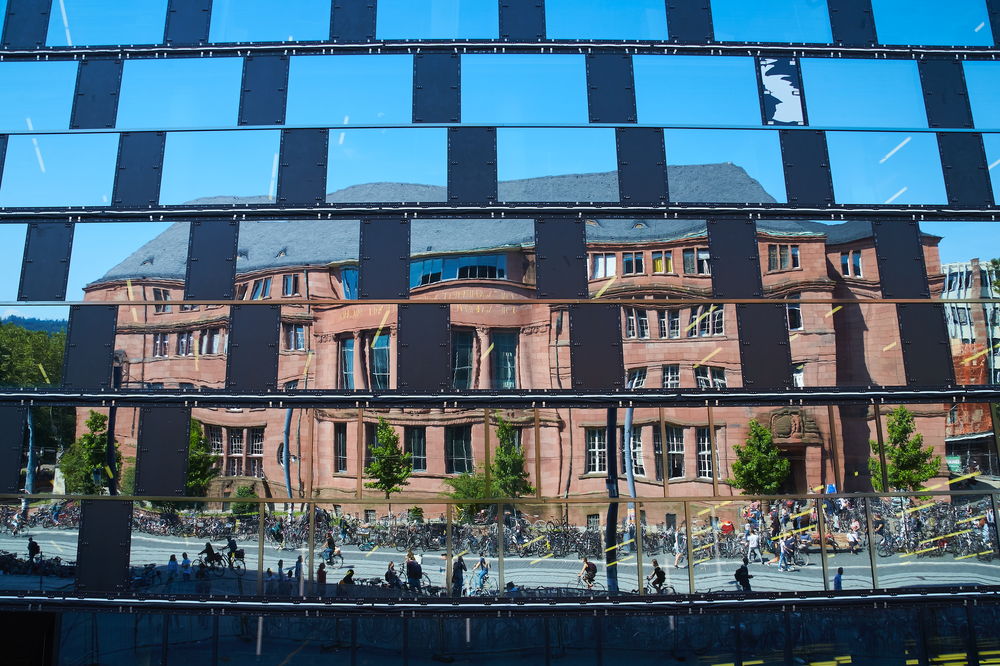
Die Fassade des Kollegiengebäude 1 spiegelt sich in der Glasfassade der Universitätsbibliothek

The Freiburg Center for Interdisciplinary Constitutional Studies (FreiCIC)

FreiCIC brings together, for the first time, a wide range of disciplinary perspectives—from law and history to literary studies and psychology—in a comprehensive and long-term effort to study constitutions as lived social practices.

To the FreiCIC website

Portrait of Dr. Elisabeth Piller

80 Years after the End of the War in Europe: How Stable Is the Postwar Order?

How stable is the world order that took shape after 1945 – and what will happen if its foundations crumble? In our interview, the Freiburg historian Jun.-Prof. Dr. Elisabeth Piller speaks about the fragile transatlantic relations and draws historical parallels between postwar periods. It is a discussion of shifts of power, emotional breaks – and the end of cherished certainties.

Read more
Portrait of Prof. Dr. Jan Eckel

A Retrospective on 150 Years of World Politics

Contemporary historian Prof. Dr Jan Eckel has been awarded the Volkswagen Foundation’s Opus Magnum grant for a book project on the history of international and transnational politics since the late 19th century. In an interview, he talks about his research interest and provides a first insight into the content of the work.

Read more
Portrait of Racha Kirakosian

Racha Kirakosian receives “Momentum Funding” from the Volkswagen Foundation

Prof. Dr. Racha Kirakosian, Chair of German Medieval Studies at the University of Freiburg’s German Department has been awarded the Volkswagen Foundation‘s Momentum – Funding for Recently Tenured Professors. This offers her the opportunity to advance the content-related and strategic development of her professorship.

Read more

Jörn Leonhard receives Gottfried Wilhelm Leibniz Prize

Prof. Dr Jörn Leonhard, Professor of Modern and Contemporary History of Western Europe at the University of Freiburg, received the Gottfried Wilhelm Leibniz Prize from the German Research Foundation (DFG) on 13 March 2024.

Read more

Interdisciplinary facilities and other structures

Collaborations

Selected collaborative projects and individual funding

Board of the key research area ‘Languages of Knowledge’